Diagnostics / test, narrow, verify
Fault codes are clues. Evidence makes the call.
Modern vehicle systems share sensors, power, data, and symptoms. A disciplined diagnostic path helps avoid replacing parts that only happen to be near the fault.
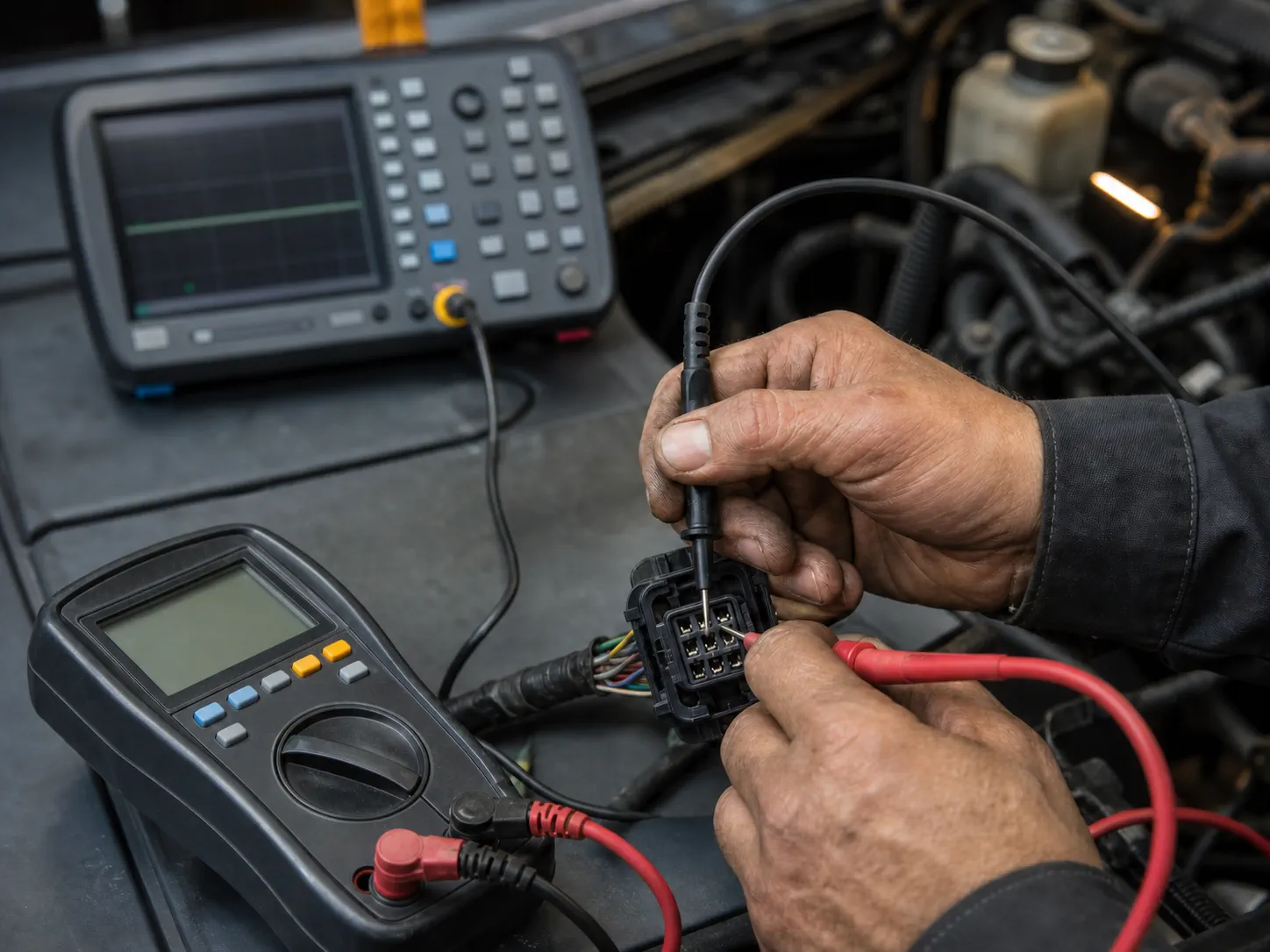
The difference between scan and diagnosis
Read the system, not just the code.
A scan can show where a control unit noticed a problem. It cannot always show whether the cause is a component, wiring, power supply, mechanical condition, software state, or another system upstream.
- 01Reproduce the reported concern
- 02Record context before clearing anything
- 03Choose the next test from evidence
- 04Repeat the check after repair
Interactive symptom guide
Start where the driver starts.
Select the closest concern to see useful preparation notes and relevant service areas. This organizes a visit; it is not a remote diagnosis.
Useful notes before a visit
- Record the exact light and colour
- Note when it appeared
- Avoid clearing codes before inspection
Relevant service areas
This guide organizes the conversation; it does not diagnose a vehicle. Stop driving if braking, steering, visibility, smoke, fire, or overheating makes the vehicle unsafe.
Diagnostic systems / compact matrix
System, symptom, test direction, outcome.
A compact evidence matrix makes the diagnostic method legible without turning the site into a parts catalogue.
| System | Common concern | Possible checks | Useful output |
|---|---|---|---|
| Starting | Slow crank, click, no response | Battery condition · voltage drop · control signal | Measured supply and control path |
| Charging | Battery warning, repeated flat battery | Charging behaviour · cable integrity · current draw | Cause separated from battery symptom |
| Engine control | Warning light, poor running, hesitation | Fault context · live values · mechanical baseline | System-level test direction |
| Braking / wheel end | Vibration, pull, noise, changed pedal feel | Wear · runout · play · hydraulic condition | Safety priority and measured recommendation |
| Cooling | High temperature, coolant loss, weak heat | Pressure · temperature · fan control · leak trace | Leak path or operating fault narrowed |
| Vehicle network | Multiple warnings, intermittent modules | Supply · grounds · communication state | Primary fault separated from secondary messages |
Diagnostic handover
Every stage should leave something useful.
A good process produces an understandable output even when further work is needed.
- 01
Listen & verify
Record the symptom, when it happens, and what changed. Reproduce the concern where practical before choosing tests.
A precise problem statement - 02
Test & narrow
Use the right visual, mechanical, electrical, or data checks to separate a symptom from its root cause.
Measured findings, not a parts list - 03
Explain & approve
Share what was found, the recommended next step, and the price or further diagnostic scope before repair work begins.
An informed decision point - 04
Repair & verify
Complete only the approved scope, then repeat the relevant check so the outcome is supported by evidence.
A recorded post-repair check
Describe the symptom, not the guessed part.
Timing, temperature, speed, warning messages, recent work, and what changes the concern can all shorten the path to a useful test.
Prepare those details